
Three years ago, Common Sense Media published research showing that 73% of American teenagers had seen online pornography, most before their thirteenth birthday – usually by accident. That report initiated difficult conversations about an internet saturated with sexual content that children were navigating largely alone. Now they have returned to the subject and the landscape they describe has shifted in ways few of us anticipated. The problem is no longer just pornography that exists and gets stumbled upon. It’s sexual imagery that can be manufactured, of anyone, by anyone, in minutes.
The new report, Teens in the AI Era: Pornography and Sexual Content draws on a nationally representative survey of 1,314 US teenagers aged 13 to 17, conducted in late 2025 alongside in-depth interviews and focus groups. Its subject is AI-generated sexual content: deepfakes, ‘nudification’ or undressing apps, and synthetic nude imagery that requires no technical skill to produce and can feature real classmates, ex-partners, celebrities – or the teens themselves.
When this content depicts anyone under 18, it constitutes child sexual abuse material and is a criminal offence in the United States. The UK’s Online Safety Act similarly criminalises the sharing of intimate images without consent, including AI-generated ones.
Conventional pornography exposure has barely moved since 2023, with 74% of teens reporting they have seen it, more than half by age 12. But the new reality is that 44% of teenagers have seen sexual content they believe was AI-generated, and for 79% of them, the exposure was accidental – appearing in their social media feeds, mixed into ordinary websites or appearing in mobile game adverts.
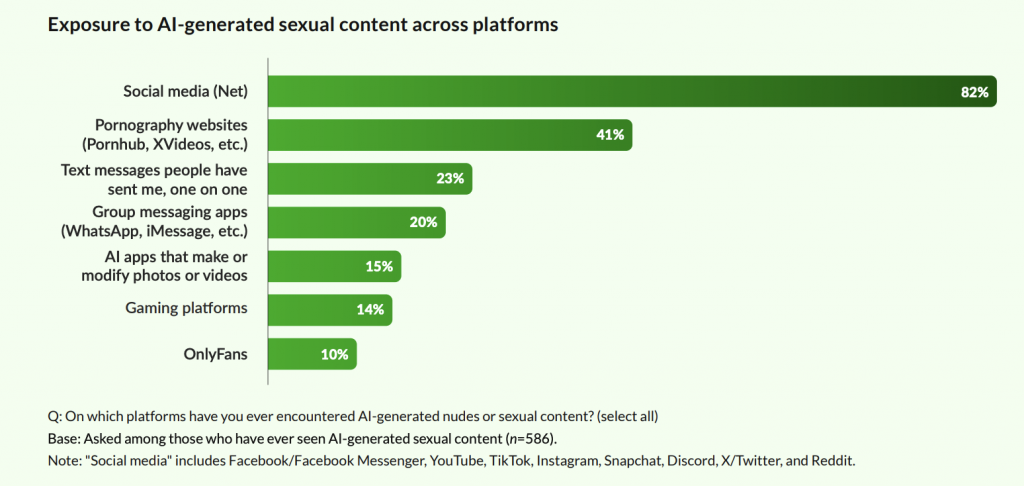
This isn’t content teens are hunting down in dark corners of the internet. It’s arriving unbidden in the spaces where they already spend large parts of their days. As one 15-year-old girl told researchers, scrolling through TikTok or Instagram, she sees so much of it that it confuses her about what’s real and what isn’t.
Among teens who have seen AI-generated sexual imagery nearly a quarter have seen it featuring themselves or someone they know personally and more than one in ten have seen sexual content of themselves. Eight per cent of teenagers admit to having created deepfakes with boys more than twice as likely as girls to have done so. Among creators and their acquaintances 63% say the content depicted people they actually know. This is what distinguishes the AI era from what came before – the girl sitting in the classroom can now be the subject of deepfake explicit imagery circulating in group chats, made by the boy sitting two rows behind her.
The report’s introduction documents such cases from the Westfield High School incident in New Jersey – where boys generated fake nudes of more than 30 female classmates – to a Louisiana middle school that expelled a victim for confronting the boy she accused of making images of her.
Two-thirds of teenagers are worried about being depicted in deepfakes without their consent and they are pre-emptively shrinking their digital lives in response.
38% are more careful about what they post, 30% have made accounts private and nearly one in ten have deleted social media accounts altogether. Girls carry more of this anxiety than boys with 71% expressing worry compared to 62%. Teenagers themselves believe the content is warping their generation’s expectations with roughly two-thirds saying it distorts perceptions of what bodies should look like, what sex and consent mean and whether photos and videos can be trusted at all.
And yet only one in five teenagers has ever discussed AI-generated sexual content with a trusted adult. A third would like to, but do not know how to start the conversation. Just 13% would feel comfortable turning to a teacher or school counsellor, and nearly one in five say they would speak to nobody at all and handle it alone. When asked what would change that their answers were simple – knowing the adult would understand, knowing they would not be blamed, and knowing their devices would not be confiscated. Meanwhile, 44% say school has taught them nothing about identifying fake or AI-generated content, and there is a genuine perceived generational divide – as one 17-year-old girl put it, “we grew as AI grew,” and adults simply do not share that life experience.
The findings here are not unique to the USA – the Children’s Commissioner for England published similar findings on nudification tools in 2025 and the Internet Watch Foundation has repeatedly warned about the growth of AI-generated abuse imagery in the UK.
For parents the single most protective thing you can do costs nothing – make it clear, before anything ever happens, that your child can come to you about anything they see online and will be met with help rather than blame or a confiscated phone. Fear of punishment is one of the biggest barriers teens name.
Treat it as a series of small low-pressure conversations rather than one major sit-down and be direct with sons in particular that creating AI nudes of anyone underage is a crime – not a joke. If your child does become a victim know the routes to redress – in the UK report to the platform, to CEOP for child sexual abuse concern and use the Internet Watch Foundation’s Report Remove tool which allows under-18s to have intimate images of themselves taken down.
For schools the report’s message is that this content is already circulating in your school – over a third of teens who know about shared deepfakes say it happened in in-person conversations at school. Address the topic before a crisis forces you to, embed AI literacy and digital consent into existing curricula and ensure staff know the safeguarding protocols, because a confident, non-judgemental response when a student comes forward is itself what builds the trust that makes the next student come forward. AI and deepfake technology has moved faster than our institutions but the adults in our children’s lives can’t afford to move slower still.